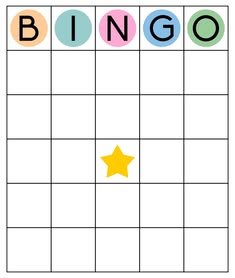
Bingo is one of the most adaptable games ever created. While traditional 5×5 grids filled with random numbers are entertaining, adjusting the complexity of the game opens up new possibilities for classrooms, corporate training sessions, family gatherings, and themed parties. Learning how to design custom boards tailored to specific skill levels ensures that every participant stays engaged, whether they are young children learning basic concepts or adults tackling complex trivia. By utilizing well-structured Bingo Vorlagen (bingo templates), you can easily scale the challenge up or down to match the exact needs of your audience.
Understanding the Core Mechanics of Bingo Difficulty
Before designing your cards, it is helpful to understand what actually makes a bingo game easy or difficult. Difficulty in bingo is controlled by four primary variables: grid size, content complexity, cognitive load required to match a square, and the winning pattern required to call bingo.
- Grid Size: A standard board uses a 5×5 grid with 24 playable spaces and one free space in the center. Reducing the grid to 3×3 or 4×4 drastically shortens the game and lowers the difficulty, while expanding to 6×6 or 7×7 increases the duration and challenge.
- Content Type: Direct matching—such as matching a called number to a printed number—requires minimal effort. Indirect matching—such as solving a math equation to find the number on the card—adds a layer of problem-solving.
- Time Constraints: Fast-paced calling forces players to scan their boards quickly, increasing pressure and perceived difficulty.
- Winning Patterns: A simple horizontal, vertical, or diagonal line is the easiest to achieve. Complex patterns like four corners, an X-shape, a picture frame, or a full blackout require significantly more luck and sustained attention.
Designing Easy Level Bingo Cards
Easy bingo cards are ideal for young children, language beginners, elderly participants, or fast-paced icebreaker games where the goal is quick engagement rather than deep mental strain.
Keep the Grid Compact
For beginners, a 3×3 or 4×4 grid works best. A 3×3 board contains only nine squares, meaning a game can be won in as few as three calls. This keeps frustration low and ensures frequent winners, which maintains high energy in a group setting. Always include a center free space on odd-numbered grids to give players an immediate head start.
Use Direct Visual or Simple Word Clues
At the easy level, the item called out by the host should match the exact item printed on the card. For young learners, use clear, high-contrast images of animals, colors, shapes, or basic sight words. If you are browsing Bingo Vorlagen for early education, look for layouts with large squares that accommodate bold illustrations and clear, sans-serif fonts.
Stick to Traditional Line Wins
Keep the rules straightforward. Allow players to win by completing any single horizontal, vertical, or diagonal row. Explaining complex patterns to beginners can slow down the game before it even starts.
Designing Medium Level Bingo Cards
Medium difficulty is the sweet spot for middle school classrooms, casual adult parties, bridal showers, and team-building events. At this stage, players are familiar with the basic rules and appreciate a mild mental challenge.
Standardize to the Classic 5×5 Grid
A 5×5 layout provides 24 active squares, offering enough variety that no two cards feel identical while keeping the game length between 15 and 30 minutes. Organize columns logically if your theme allows it, similar to how traditional bingo separates numbers into B-I-N-G-O columns.
Introduce Indirect Matching and Clues
Instead of calling out the exact word or number on the card, have the host read a clue, definition, or simple prompt. For example, in a vocabulary game, the host reads the definition, and players must find the corresponding word on their board. In a music-themed game, the host plays a ten-second clip of a song, and players mark off the song title or artist. This transforms bingo from a game of pure luck into an interactive quiz.
Experiment with Intermediate Patterns
Move beyond single lines by introducing multi-line or shape-based winning conditions. Popular medium-difficulty patterns include:
- Four Corners: Players must mark the four outer corners of the grid.
- The Letter T or L: Players complete the top row and middle column, or the left column and bottom row.
- Postage Stamp: Players mark a 2×2 block of squares in any corner of the board.
- Double Bingo: Players must complete two separate lines on the same card before winning.
Designing Hard Level Bingo Cards
Hard bingo cards are built for trivia enthusiasts, advanced students, corporate workshops, and competitive game nights. These boards require concentration, subject-matter expertise, and strategic scanning.
Expand the Grid or Remove the Free Space
To increase difficulty immediately, remove the center free space on a 5×5 grid, forcing players to earn all five squares in a center row or column. For an even greater challenge, create a 6×6 grid with 36 active squares. Larger grids require sharper visual scanning and reduce the statistical probability of quick wins.
Use Multi-Step Problem Solving and Trivia
Make players work for every single square. In an educational setting, the host might call out a complex algebraic equation, and players must calculate the answer before checking if that number appears on their grid. In a historical or pop-culture trivia game, clues can be layered with riddles or indirect references. You can also include “decoy” answers on the cards—words or numbers that are closely related to the clue but incorrect—to prevent players from guessing blindly.
Implement Complex Winning Conditions
Hard bingo games thrive on demanding patterns that keep everyone playing until the very end:
- Blackout (Coverall): Every single square on the card must be marked. This is the ultimate test of endurance and attention.
- The Frame: Players must mark every square along the outer perimeter of the board.
- The Diamond or Cross: Specific internal geometric shapes that ignore the easier outer edges.
- Rotating Patterns: The host changes the required winning pattern every five calls, forcing players to constantly re-evaluate their boards.
Practical Tips for Creating and Customizing Your Cards
Regardless of the difficulty level you choose, presentation and randomization are critical to a smooth game experience.
Ensure Proper Randomization
If multiple players share identical rows or columns, several people will call bingo at the exact same time, which can diminish the excitement. When building custom boards from scratch or adapting existing Bingo Vorlagen, make sure the placement of items is thoroughly shuffled for every individual sheet. Aim for at least 30 to 40 unique items in your master pool for a standard 5×5 grid so that every card has a distinct distribution.
Prioritize Clean Typography and Layout
Even the hardest trivia bingo game should not be difficult because the text is unreadable. Use legible fonts, keep text concise so it fits comfortably inside each cell, and leave enough white space around words or icons so players can place chips or use daubers without obscuring neighboring squares.
Test Your Clues Before Hosting
Before printing or distributing digital cards, run through a quick test round. Verify that every clue has only one unambiguous match on the board, especially at medium and hard difficulty levels. Clear clues prevent mid-game disputes and keep the momentum moving smoothly from the first call to the final winner.